
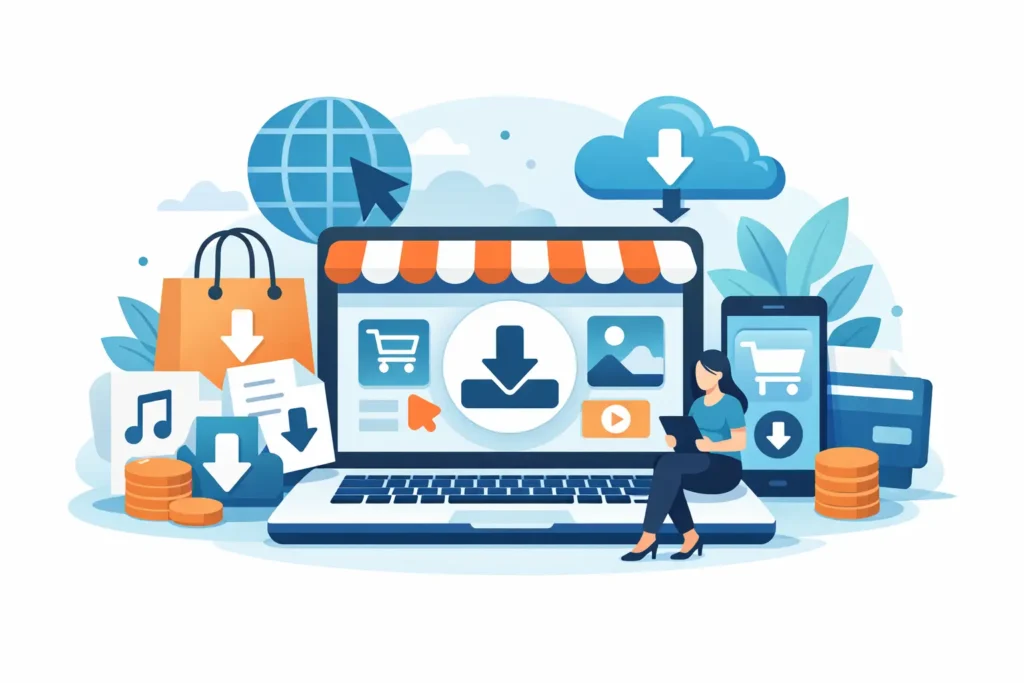
A lot of people get stuck before they make their first sale because they think they need to create a huge course, build a complicated website, or become a designer overnight. You don’t. If your goal is to sell downloadable products online, the fastest path is usually the simplest one: pick a product people already want, package it clearly, and get it in front of buyers who need a shortcut.
That matters because downloadable products are one of the few business models with low overhead, instant delivery, and room to scale without adding inventory or shipping stress. You make it once, improve it over time, and sell it again and again. For side hustlers, beginner creators, and anyone trying to build income without starting from zero, that is a serious advantage.
Why sell downloadable products online?
Digital downloads work because they solve immediate problems. A Canva template saves someone hours. A reel bundle gives a creator content they can post today. A webinar deck helps a coach look polished without hiring a designer. People are not just buying files. They are buying speed, convenience, and a faster route to results.
That is why the best-selling downloadable products are rarely the most complicated. They are the most useful. Buyers want something they can access now, understand fast, and put to work without a learning curve that eats up their weekend.
There is also a second layer of value that smart sellers use well: monetization potential. Products with PLR or MRR rights can be especially attractive because they help buyers do more than use the product. They can often modify, brand, and resell it depending on the license terms. For a buyer who wants to start an online business quickly, that makes the purchase feel more like an asset than an expense.
What to sell when you want to start fast
If you are new, do not overcomplicate product selection. Start with formats that are easy to produce, easy to deliver, and easy for the customer to understand. Templates, swipe files, mockups, planners, presentation decks, social media content packs, lead magnets, printable business tools, and storefront bundles all fit this model.
The best option depends on who you want to serve. If your audience is creators, short-form video templates or caption packs can work well. If your audience is small business owners, ad creative bundles or sales page templates may be stronger. If your audience is aspiring digital sellers, ready-made product kits with resale rights can be the fastest route because they shorten the gap between buying and earning.
A common mistake is choosing a product based only on what is easy to make. Easy for you is good, but useful for them matters more. A plain checklist can outsell a polished 100-page workbook if it helps the buyer get a clear win in less time.
How to sell downloadable products online without wasting time
The fastest sellers usually do three things well. They make the offer obvious, they reduce friction, and they sell the outcome instead of the file format.
Start with the offer itself. Your product should answer one simple question: what will this help me do? If your listing says “50 Canva templates,” that is a feature. If it says “50 Canva templates to help beauty brands post faster and look premium,” that is a stronger offer. Specificity sells.
Next, make the buying process clean. People should know what they get, how they receive it, and whether they can use it for personal use, client work, or resale. If your licensing is part of the value, say that clearly. If modifications are allowed, say that too. Confusion kills conversions.
Then focus your product page on proof and practical value. Show mockups. Describe use cases. Explain who it is for and who it is not for. Mention the time saved, the business use, and the result the buyer can reasonably expect. Keep it direct. Buyers are not looking for a lecture. They are looking for a shortcut they can trust.
Pricing for momentum, not hesitation
Pricing is where many beginners freeze. They either price too low because they feel new, or too high because they imagine the value instead of matching buyer expectations. A better approach is to price based on transformation, immediacy, and market positioning.
Low-ticket products can work well when they solve a narrow problem fast. Think impulse-buy territory. Mid-ticket bundles make sense when the buyer is getting breadth, convenience, or resale potential. If a bundle saves hours of creation time or gives the buyer a ready-made product line, the higher price is easier to justify.
It also helps to think in terms of laddered offers. A smaller product can bring in first-time buyers. A bundle can increase average order value. A larger package with commercial-use or resale-friendly licensing can serve the buyer who wants speed and scale. You do not need ten offers. You need a clear next step.
Discounting can help, but only when used with intention. Permanent fake sales weaken trust. A launch offer, bundle savings, or limited-time upgrade can create momentum without making your products feel disposable.
Traffic comes after clarity
Many people ask how to get traffic before they have a clear offer. That is backwards. If your product page is vague, more traffic just means more people leaving.
Once your offer is strong, traffic becomes much easier to work with. Short-form content is one of the best ways to attract attention because it lets you show the product in action. A template before-and-after, a quick walkthrough, or a “here’s what you get” clip can do more than a long explanation. Email marketing also matters because downloadable products pair well with lead magnets, launch announcements, and bundle promotions.
You do not need to be everywhere. Pick one main channel where your audience already spends time and commit to clear, repeatable content. If your audience is made up of online entrepreneurs and creators, content around speed, monetization, and done-for-you assets usually performs well because it connects directly to what they want: faster execution and income potential.
If you want to mention your store once and keep moving, that is enough. A marketplace like How To Make Money Online Store makes sense when the brand promise is clear and the buyer knows they can get immediate access to business-ready digital assets.
The real difference between products that sell and products that sit
Usually, it is not talent. It is positioning.
A product sits when the seller describes what it is but not why it matters. A product sells when the buyer can picture using it right away. That means your naming, visuals, and copy all need to point to action.
For example, “Instagram bundle” is broad. “Faceless Instagram content bundle for affiliate and digital product sellers” is much stronger because it gives the buyer an identity and a use case. That kind of positioning attracts the right person faster and filters out the wrong one.
This is also where beginners have an advantage. You are often closer to the buyer’s current problems, so you know what feels confusing, time-consuming, or intimidating. Build around those pain points. Sell relief. Sell speed. Sell the first step made easier.
Licensing can be a growth lever
Not every downloadable product needs resale rights, but when licensing is relevant, it can seriously increase perceived value. PLR and MRR can turn a basic digital file into a business asset. That changes how buyers evaluate the purchase.
There is a trade-off, though. The more flexible the license, the more important it becomes to explain the boundaries. Can the buyer edit the product? Rebrand it? Bundle it? Resell it as-is? Use it for clients? Clear terms protect trust and reduce refund issues.
If your audience wants to build income streams quickly, licensing is not a side note. It can be the reason they buy. Just make sure the rights are presented simply. People should not need a legal dictionary to understand what they can do with your product.
Start lean, then improve from real sales
You do not need a giant catalog to build momentum. One solid product can teach you what your audience wants, what messaging converts, and where buyers hesitate. That feedback is worth more than spending three months making a bloated store no one asked for.
Launch with a product that solves one clear problem. Watch what questions buyers ask. Notice which visuals get clicks. See what content drives visits. Then improve the offer, expand the bundle, or create the next product based on actual demand.
That is how smart digital sellers grow. Not by waiting until everything looks perfect, but by getting a useful product into the market and sharpening it with each sale.
If you are ready to build online income, do not wait for the perfect idea. Pick a product that saves time, helps someone make progress, and can be delivered instantly. Then put it in front of the people who already want the shortcut.