
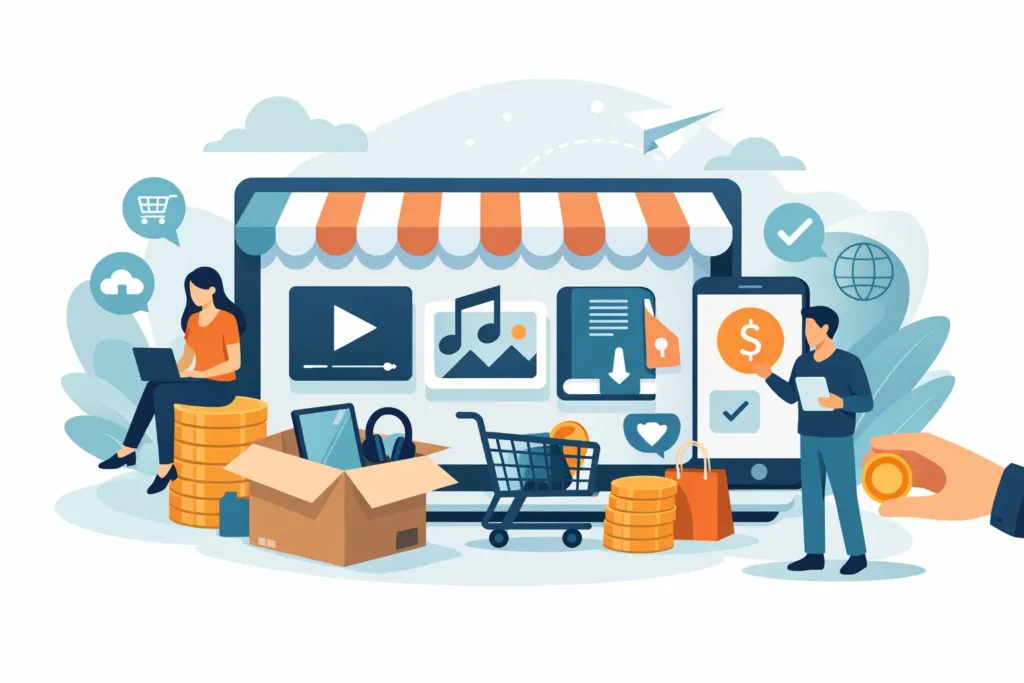
If you’re trying to sell digital products for free, the real question is not whether it can be done. It can. The better question is how far you can get without paying upfront, and where free starts costing you time, control, or profit. That distinction matters if you’re building an online income stream on a tight budget and want results without wasting weeks on the wrong setup.
The good news is you do not need a fancy website, paid software, or a full brand team to get started. You need a product people want, a place to list it, and a simple way to get attention. That is enough to make your first sales. For beginners, that is the fastest path forward.
What it really means to sell digital products for free
Selling for free usually means no upfront cost to launch. It does not always mean zero cost forever. Many free platforms make money by charging transaction fees, taking a percentage of sales, or limiting advanced features until you upgrade.
That is not necessarily bad. In fact, for a new seller, paying only when you make a sale is often better than paying monthly before your offer is proven. Free can be a smart testing ground. It gives you room to validate your product before you invest more money into branding, ads, or a custom storefront.
Still, you need to be clear on the trade-off. A free setup is great for momentum. It is not always great for long-term margin or full ownership. If your goal is to start quickly, free works. If your goal is to scale aggressively, you will probably outgrow some of those tools.
The easiest way to start selling without upfront costs
The simplest route is to use a marketplace or creator platform that lets you upload a digital file, set a price, and collect payments without paying monthly fees. This is ideal for products like templates, ebooks, planners, guides, social media packs, mockups, presentation decks, or editable content bundles.
These platforms are useful because they handle the technical side for you. Delivery is automatic. Payment processing is built in. Customers can buy instantly. That matters when you want speed and low friction.
The downside is that you’re building on rented space. Your product page may look like everyone else’s. Your branding options may be limited. And if the platform changes its rules, fees, or visibility, you have to adjust.
That said, for a side hustler, beginner creator, or someone testing product-market fit, this is still one of the smartest ways to begin.
What kind of digital products work best on a free setup
Not every digital product is equally easy to sell when you’re starting from zero. Products that solve a clear problem fast usually win first. Think done-for-you templates, editable kits, swipe files, checklists, workbooks, planners, faceless content packs, or low-cost business resources.
Why do these work? Because buyers do not want more complexity. They want shortcuts. They want something they can download and use today. The easier your product is to understand, the easier it is to sell with organic traffic and simple content marketing.
This is also why resale-friendly products get attention. If a buyer can use a product and monetize it, the perceived value goes up. That model speaks directly to people who want assets, not just information. It lowers the barrier to starting an online business because they are not creating from scratch.
How to sell digital products for free without a website
You do not need your own website on day one. A strong product page plus a social content strategy can do a lot of heavy lifting.
Start with one focused offer. Do not launch ten random products and hope something sticks. Pick one product that solves one specific problem for one specific person. A niche Canva bundle for realtors is better than a vague social media pack for everyone. A faceless content kit for small business owners is easier to market than a general “creator bundle.”
Then write a product title and description that are built around outcomes. People buy the result, not the file type. They do not care that it includes 75 editable slides until they understand what those slides help them do. Lead with speed, convenience, and payoff.
Your social channels then become your traffic engine. Short-form videos, Pinterest pins, before-and-after visuals, tutorials, and simple problem-solution posts can move people to your product page without paid ads. If your audience hangs out on Instagram, TikTok, YouTube Shorts, or Pinterest, use those channels to show the product in action.
You do not need polished perfection. You need proof that the product is useful.
Free traffic is the real job
Most people get stuck on platform choice when the real challenge is traffic. You can list a great product for free and still make zero sales if nobody sees it.
That is why content matters. Free selling works best when your content does one of three things: shows a transformation, teaches something useful, or taps into a result your audience already wants. If you’re selling templates, show how they save time. If you’re selling content packs, show how they help someone post consistently. If you’re selling MRR or PLR-friendly assets, show how they can be rebranded and turned into income.
You do not need to go viral. You need consistency and relevance. A small audience that trusts you will often outperform a large audience that barely pays attention.
This is also where beginners can build momentum fast. One product can generate multiple content angles. A planner becomes productivity content. A storefront bundle becomes business setup content. A reel pack becomes visibility content. You are not just selling files. You are selling a shortcut to a better result.
Pricing matters more than people think
When you’re trying to sell digital products for free, pricing can either help you get traction or quietly kill your offer. If your price is too high for a cold audience, people hesitate. If it is too low, they may assume it has little value.
For a first product, a low-ticket price often makes sense. It reduces friction and gives you a quicker path to proof. Once you have sales, testimonials, and customer feedback, you can raise prices, bundle offers, or add upgrades.
There is no perfect price that works for every niche. A niche business template can command more than a general checklist. A resellable bundle can justify more than a single-page download. It depends on usefulness, speed, and perceived earning potential.
The smartest move is to test. Let the market tell you what feels like a no-brainer.
When free platforms are enough and when they are not
Free platforms are enough if you are validating an idea, building your first audience, or trying to get your first 10 to 50 sales. They help you move fast and avoid upfront risk. For many creators, that is exactly what they need.
They are not enough when you want full brand control, deeper email automation, better upsells, stronger analytics, or higher margins. At that point, graduating to a more advanced setup can make sense because the business is already producing revenue.
That is the key mindset shift. Do not start by trying to look big. Start by trying to prove demand. A simple product with clear positioning will beat an expensive setup with no audience almost every time.
A smarter path for beginners who want speed
If creating from scratch feels overwhelming, start with ready-made assets you can customize, package, and position for a specific buyer. This is where templates, editable resources, and products with resale rights become powerful. They cut your creation time and let you focus on what actually drives sales: positioning, presentation, and promotion.
That is often the difference between people who stay stuck and people who launch. One group keeps planning. The other picks an asset, improves the offer, and gets it in front of buyers.
If your goal is to build an online income stream without spending a lot upfront, free tools and free selling platforms can absolutely help you start. Just do not confuse free with effortless. The money is not in listing a file. The money is in choosing a product people already want, presenting it clearly, and showing up consistently enough for buyers to trust you.
Start simple. Make the offer easy to understand. Give people a reason to buy now. And if you want to build faster, use tools and assets that shorten the road between idea and income. That is how small digital products turn into real momentum.