
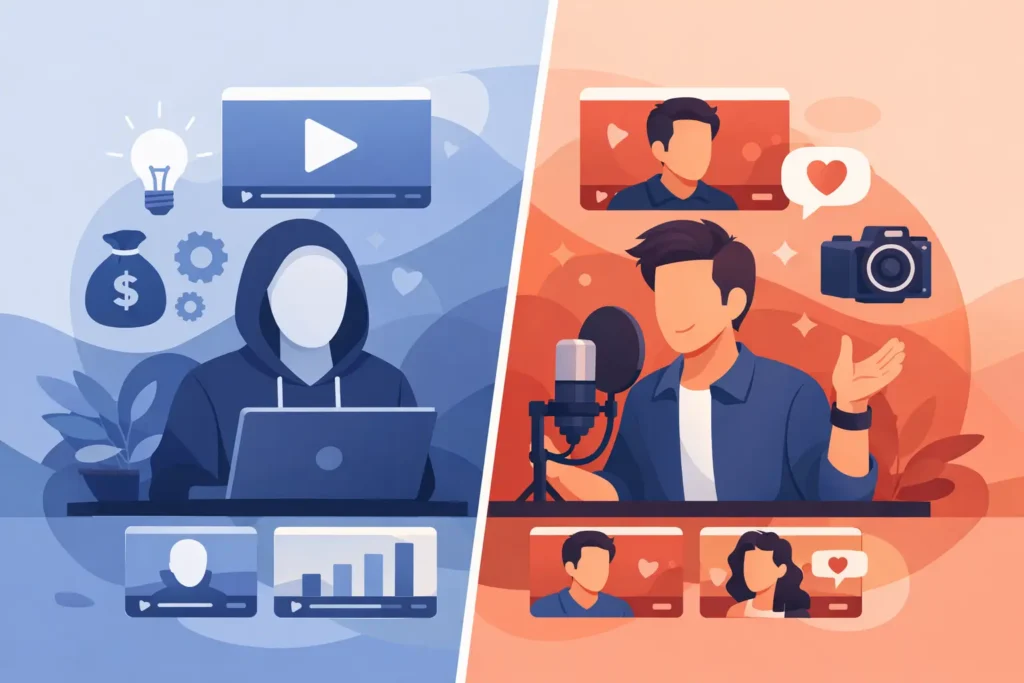
Pick the wrong content model, and you can waste six months building an audience you do not even want to maintain. That is why the faceless YouTube vs personal brand decision matters so much. It is not just about content style. It shapes how you make money, how fast you can start, how much privacy you keep, and how hard your business is to scale.
If your goal is online income, both models can work. But they work in different ways, and they attract different kinds of opportunities. One gives you speed, systems, and more privacy. The other gives you trust, loyalty, and stronger long-term leverage. The best choice depends on what you want to sell, how visible you want to be, and how involved you want to stay in the business.
Faceless YouTube vs personal brand: what changes when you choose one?
A faceless YouTube channel is built around content, not personality. The audience follows the topic, the format, and the value of the videos. You might use voiceovers, stock footage, screen recordings, animation, AI-assisted visuals, clips, or text-based storytelling. The brand can feel polished and scalable because the creator does not have to be the product.
A personal brand works differently. People are buying into your opinions, your story, your personality, and your expertise. Your face, name, and perspective become part of the marketing. That usually creates a stronger emotional connection, but it also creates more dependence on you showing up consistently.
For beginner creators, the biggest mistake is thinking one model is automatically better. It is not. A faceless channel can generate traffic and sales without requiring daily visibility. A personal brand can convert faster because trust is easier to build when people know who is talking to them. The trade-off is simple: faceless is often easier to systemize, while personal branding is often easier to deepen.
When faceless YouTube makes more sense
If you care about speed, privacy, and repeatable production, faceless YouTube is often the smarter starting point. It fits people who want to build a digital asset that can run more like a media business than a creator diary.
This model works especially well in educational and problem-solving niches. Think tutorials, product roundups, side hustle ideas, motivation, digital product tips, business explainers, software walkthroughs, finance basics, or niche entertainment. The viewer clicks because the topic solves a need, not because they are loyal to your identity.
That matters for scaling. Once you find a format that gets views, you can outsource pieces of the process. Scriptwriting, voiceovers, editing, thumbnail design, and research can all be delegated over time. You are building a machine, not just a reputation.
For side hustlers and digital product sellers, that is a big advantage. If you want to promote templates, toolkits, PLR bundles, MRR products, storefront assets, or educational resources, faceless content can attract search-based traffic without making you the center of every sale. You can focus on the offer and the audience problem.
There is another reason people choose this path: they do not want their income tied to their face forever. That is a valid business decision. Privacy is not fear. Sometimes it is strategy.
Still, faceless YouTube has limits. It can take longer to build deep loyalty. Some niches are crowded with low-effort content, which means quality matters more than people think. And if your videos feel generic, your audience may watch once and never remember your channel.
When a personal brand wins
A personal brand tends to move faster when trust is the main conversion driver. If you are selling coaching, consulting, speaking, premium education, community access, or any offer where buyers need confidence in you, personal branding usually has the edge.
People buy from people they believe. When your face is on camera, your voice is familiar, and your story feels real, trust compounds faster. Viewers start to feel like they know you. That can shorten the path from attention to sale.
This is especially powerful if your experience is part of the product. If you are teaching how you grew a store, built an audience, sold digital products, or created income streams, your personal proof becomes part of your positioning. You are no longer just publishing information. You are showing evidence.
That can also lead to stronger brand equity. A personal brand can expand into newsletters, memberships, affiliate deals, courses, masterminds, events, and partnerships with less friction because the audience connection is already there.
But there is a cost. A personal brand is harder to separate from your daily energy. If you stop showing up, growth can slow down fast. If you pivot niches, your audience may not follow. And if you value privacy, this model can feel draining over time.
There is also pressure. Some creators discover that building around themselves makes every post feel personal. That can create hesitation, overthinking, and burnout. When your identity becomes your content strategy, stepping back gets harder.
Money potential: which model earns more?
This is where people want a clear winner, but the real answer is that each model monetizes differently.
Faceless YouTube can be strong for ad revenue, affiliate marketing, traffic generation, and digital product sales at scale. Because the content is topic-led, you can create a larger volume of videos around searchable demand. That gives you more shots at traffic. If your funnel is clean, those views can turn into email leads and product buyers without requiring a high-touch relationship.
A personal brand often makes more per customer. Trust usually improves conversion rates, especially for premium offers. You may need fewer views to make the same revenue because the audience is warmer and more invested. If you are selling higher-ticket products or personalized services, this matters a lot.
So the better question is not which earns more. It is which earning model fits your business. If you want lower-cost offers, volume, and scalable traffic, faceless content has a real advantage. If you want authority, premium positioning, and stronger audience loyalty, a personal brand can be more profitable.
Faceless YouTube vs personal brand for beginners
For beginners, the easiest choice is often the one that removes resistance. If being on camera is the only thing stopping you from starting, faceless YouTube is the obvious move. Starting imperfectly with a model you can actually stick to beats waiting for confidence that may never arrive.
If you are naturally expressive, comfortable speaking, and willing to build trust publicly, a personal brand may help you gain traction faster. People connect with conviction. If you have that skill, use it.
Your offer should guide the decision too. Selling downloadable products, content assets, design templates, or business resources often pairs well with faceless content because the focus stays on the outcome. You can create niche channels around problems and direct viewers toward ready-made solutions. That is part of why many online income brands use content systems instead of personality-led marketing for every platform.
On the other hand, if your sales depend on your insight, your methods, or your personal story, hiding behind a logo may slow you down.
The hybrid model is often the smartest move
A lot of creators treat this as a strict either-or decision when the better move is often a hybrid. You can use faceless YouTube for reach and use a light personal brand for trust.
That might look like running a faceless tutorial channel while showing your personality on Instagram stories, email, or short-form content. Or it might mean building a branded YouTube channel with mostly screen recordings and voiceovers while still letting your audience know who is behind it.
This approach gives you flexibility. You can scale the content engine without making every sale dependent on your face. At the same time, you are not hiding so much that trust becomes a bottleneck.
For many digital product businesses, this is the sweet spot. You create content that is easy to produce, searchable, and systemized, then layer in enough personality to build buyer confidence. That is practical, profitable, and easier to sustain.
How to choose without overthinking it
Ask yourself three simple questions. First, do you want to be known, or do you want your content to be known? Second, are you building a personality-driven business or an asset-driven business? Third, if this works, do you want more visibility or more leverage?
Your answers will tell you a lot.
If you want a business that feels more operational, more private, and easier to delegate, faceless YouTube is likely the better fit. If you want stronger audience attachment, faster trust, and room to sell premium offers under your own name, a personal brand is likely the stronger play.
Neither path is lazy money. Both require consistency, positioning, and smart offers. But one can fit your life and business goals much better than the other. That is the part worth getting right.
If you are still stuck, choose the model that helps you publish this week, not someday. Momentum beats theory every time, and the creator who starts building now is the one with a real business six months from today.