
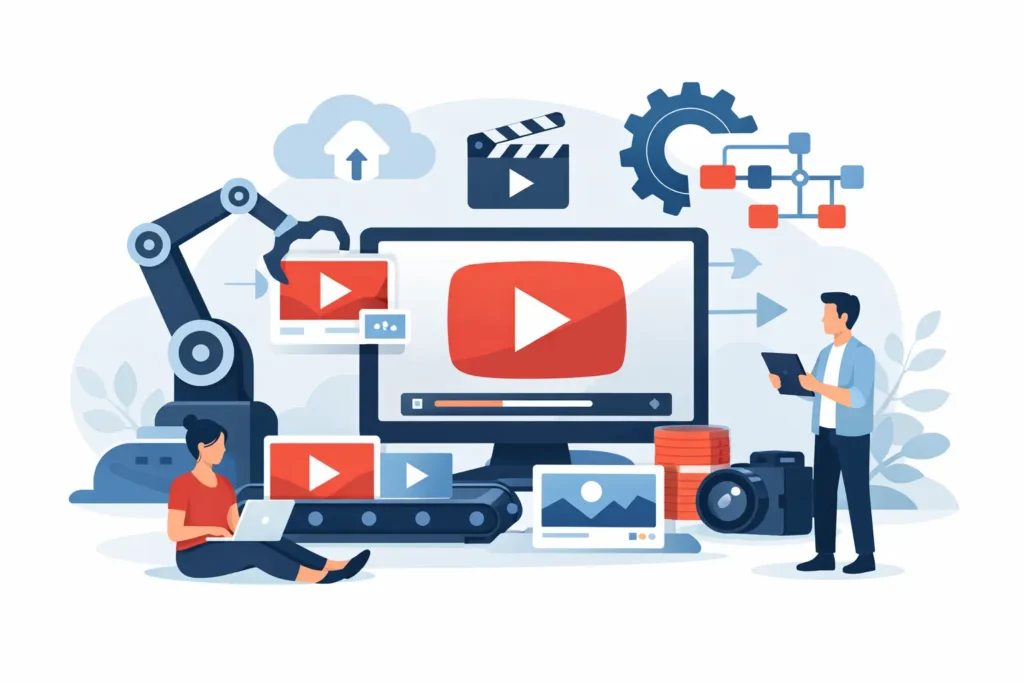
Most people do not fail on YouTube because they lack ideas. They fail because every video starts from zero. That is exactly why a youtube automation content system matters. When your content process is built like a machine instead of a guessing game, you stop chasing motivation and start producing assets that can grow traffic, leads, and income.
If you want faceless content, a side hustle that does not eat your entire week, or a channel model you can actually repeat, the goal is not to upload more random videos. The goal is to create a system that turns one idea into a script, voiceover, visuals, edit, thumbnail, title, and upload plan without you rebuilding the workflow every time.
What a youtube automation content system actually is
A youtube automation content system is a repeatable workflow for planning, creating, publishing, and improving videos with as little friction as possible. Automation does not mean you press one button and money shows up. It means the moving parts are organized so content can be produced faster, delegated more easily, and improved with data instead of guesswork.
That system usually includes topic research, script creation, production templates, editing rules, thumbnail design, publishing checklists, and performance tracking. In simple terms, you are building a content factory. The difference is that a smart factory still needs direction.
This is where beginners often get confused. They think automation means removing effort. What it really means is removing repeated decisions. That is what saves time. That is what makes scale possible.
Why this model works for side hustlers and digital sellers
If you are building an online income stream, YouTube can do more than collect views. It can feed your offers, grow your email list, validate product ideas, and create trust at scale. A well-built youtube automation content system gives you leverage because each video becomes a marketing asset that works after you publish it.
That matters even more if you sell digital products, templates, toolkits, PLR offers, or creator resources. You do not need to be on camera every day to make sales. You need content that solves a specific problem, attracts the right viewer, and points them toward the next step.
The upside is obvious. Once the workflow is set up, one person can produce much more than they could with a traditional creator model. The trade-off is that low-effort content usually looks low-effort. If your videos feel generic, the system will scale mediocrity. Your edge still comes from useful ideas, strong positioning, and consistency.
Start with one channel goal, not ten
Before you build the system, decide what the channel is supposed to do. A lot of automation channels stay stuck because they mix entertainment, education, motivation, and selling without a clear strategy.
Pick one main goal. Maybe you want ad revenue. Maybe you want affiliate-style traffic later. Maybe you want to sell digital products or build an audience for a storefront. One goal creates cleaner decisions across topics, calls to action, and video structure.
For most beginner entrepreneurs, the strongest play is to use YouTube as a traffic and trust channel first. Ad revenue is nice, but audience ownership and product sales can move faster if your content is tied to a clear problem people already want solved.
Build the system in five core stages
1. Topic sourcing
Your first stage is idea generation. This should not depend on inspiration. Create a running content bank based on search demand, audience pain points, competitor patterns, comments, and recurring beginner questions.
If your niche is online income, for example, your topics should focus on outcomes people already want: faceless content ideas, beginner digital products, selling templates, monetizing short-form content, or building income streams without advanced skills. Broad topics get views. Specific topics attract buyers.
A simple rule helps here: build content around problems that lead naturally to products. That is how your channel supports your business instead of becoming a separate job.
2. Script production
This is where your youtube automation content system starts saving serious time. Instead of writing every video from scratch, create 3 to 5 script frameworks.
One framework might be problem-solution. Another might be mistakes to avoid. Another could be step-by-step walkthrough. Keep the opening tight, the structure predictable, and the payoff clear. When your templates are set, scriptwriting becomes a fill-in process instead of a blank-page struggle.
Do not overcomplicate this stage. A script only needs to hold attention and move clearly. Fancy wording does not outperform clarity. If your audience is made of beginners and side hustlers, simple language wins.
3. Asset creation
Once the script is done, your assets should follow a template. That includes voiceover style, background music rules, B-roll categories, on-screen text styles, brand colors, lower-thirds, transitions, and thumbnail layouts.
This is the stage where ready-made content tools make a huge difference. Templates cut production time because you are not redesigning the video every single time. That is one reason digital product sellers and content entrepreneurs often move faster than creators who custom-build everything. Execution speed matters.
Still, there is a balance. If every video looks identical, your channel can feel stale. Keep the structure consistent but rotate visual hooks so the content stays fresh.
4. Publishing workflow
A real system includes the upload process too. Your title formula, description structure, keyword placement, thumbnail review, and posting cadence should all be documented.
This is not glamorous work, but it protects momentum. When you know exactly what happens before a video goes live, you remove delays. One missed step does not kill a channel. Repeated inconsistency does.
5. Optimization loop
This is the part most people skip. They publish and hope. A stronger youtube automation content system tracks what actually performs, then feeds those lessons back into the next videos.
Watch for click-through rate, average view duration, retention drop-off, and the topics that generate the best viewer response. If people click but leave early, your packaging is stronger than your content. If they watch but do not click, your content may be fine but your thumbnail and title need work.
The system gets smarter over time when feedback is part of the workflow.
The fastest way to make it easier to delegate
If you ever want to outsource, document everything while you are still doing it yourself. Record your script style, visual guidelines, thumbnail rules, and editing preferences in plain language. That way you are building a business asset, not just a personal habit.
This matters if your bigger plan includes scaling digital products, storefront traffic, or multiple faceless channels. Delegation works best when tasks are standardized. Otherwise, you are still the bottleneck.
A lot of entrepreneurs wait too long to create SOPs because they think they are too small. That is backwards. Systems are what help you stop being small.
Common mistakes that kill automation channels
The biggest mistake is choosing a niche only because it looks easy. Easy niches get crowded fast. If there is no clear audience pain point, your videos become forgettable.
The second mistake is relying on volume over quality. More uploads do not fix weak hooks, boring scripts, or bad thumbnails. A broken system at high speed is still broken.
The third mistake is building content with no monetization path. Views feel exciting, but random views do not always become revenue. If your channel has no connection to a product, service, or lead strategy, you may be growing attention without building income.
That is why smart creators pair content with assets people can actually use. A printable, template, bundle, or done-for-you resource gives your audience a next step. It also gives your content a business model beyond ad payouts.
How to keep the system profitable
Keep your production lean. Start with formats that are simple to repeat. Focus on topics with commercial intent. Reuse winning structures. Improve based on data, not emotion. And do not confuse busywork with output.
If you are serious about online income, think like an operator. Every video should either build authority, attract the right audience, or move people toward an offer. When that happens consistently, the channel stops being content for content’s sake.
For brands and sellers in the make-money-online space, this is where a platform like How To Make Money Online fits naturally. Ready-made templates, faceless content assets, and monetization-friendly resources can shrink setup time and help you move from idea to execution much faster.
A youtube automation content system is not magic. It is structure. It is clarity. It is the decision to stop creating randomly and start building a machine that supports your goals. Start simple, tighten the workflow, and let each video become one more asset working for your future.