
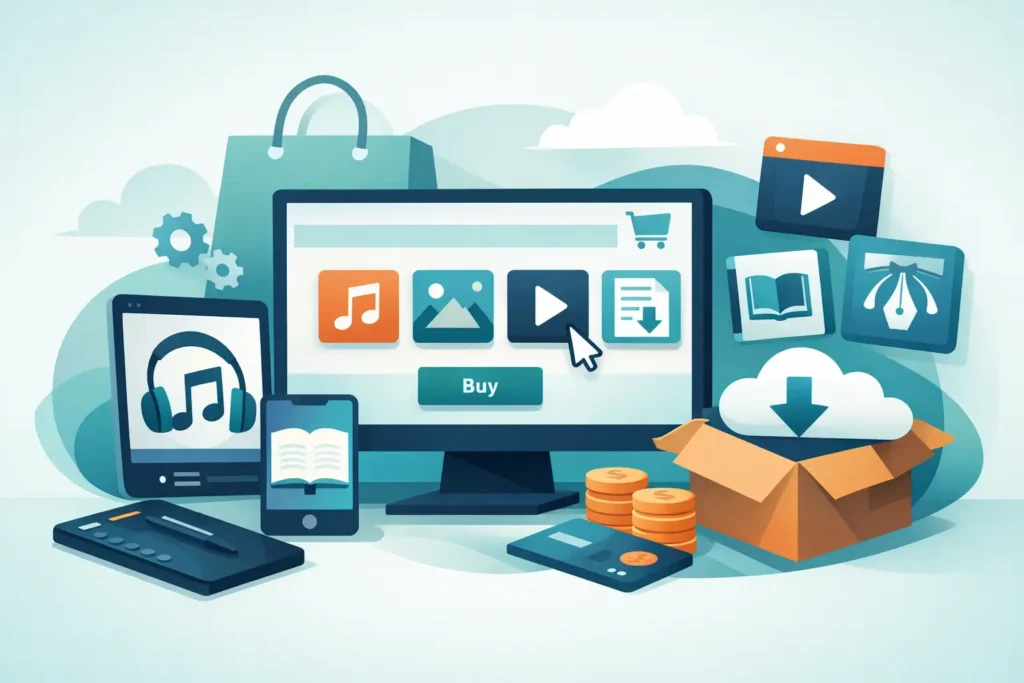
Most people don’t get stuck because Shopify is hard. They get stuck because they don’t know what digital products can you sell on Shopify that people will actually pay for. That’s the real question. If you pick the right product type, Shopify can become a simple storefront for income that doesn’t depend on inventory, shipping, or packing boxes at midnight.
The good news is you have more options than most beginners realize. The better news is you do not need to invent everything from scratch. Some of the easiest digital products to sell are practical, low-friction assets people can use right away, improve, and in some cases even resell if the license allows it. That matters when your goal is speed, simplicity, and revenue.
What digital products can you sell on Shopify?
Shopify works especially well for downloadable products that solve a clear problem fast. Think templates, planners, guides, branded assets, content packs, mini courses, and design resources. If a customer can buy it, download it, and use it within minutes, it usually fits the platform well.
That does not mean every digital product performs equally. The strongest products usually sit in one of three categories. They either save time, make money, or make someone look more professional. If your offer hits one of those outcomes, you are already in a better position than sellers offering random files with no clear use case.
Templates are one of the easiest wins
Templates are often the fastest digital product to launch because they remove the hardest part for the buyer – starting. People love plug-and-play assets. Canva templates, Instagram post packs, Reel covers, webinar slide decks, lead magnet layouts, media kits, ebook designs, and presentation templates all fall into this category.
They sell because the value is obvious. A small business owner, coach, freelancer, or creator can take a template, customize it, and publish something polished without hiring a designer. That makes templates especially strong for beginner sellers. You are not asking customers to learn a complex system. You are giving them a shortcut.
There is one trade-off, though. Templates are popular, which means they can also be competitive. If you sell them, niche positioning matters. “Social media templates” is broad. “Faceless YouTube thumbnail templates for finance creators” is more specific and easier to market.
Content packs can turn speed into sales
Content packs are another strong fit for Shopify. These include caption bundles, hook libraries, email swipe files, content calendars, ad creative packs, short-form video scripts, motivational quote packs, and niche post ideas.
This category works because content is a bottleneck for almost everyone. Business owners know they need to post, email, promote, and sell. They just do not want to stare at a blank screen every day. If your product helps them publish faster, it has real value.
For this audience, content tools can be especially attractive when they come with rebrandable rights or editable files. A creator is not just buying inspiration. They are buying execution. That is a stronger selling angle than “here are 100 prompts” with no business outcome attached.
Best digital products to sell on Shopify for beginners
If you are new, start with products that are simple to deliver and easy to explain. The biggest beginner mistake is creating something huge before validating demand. A 12-module course sounds impressive, but a clean template bundle may sell faster and be easier to support.
Planners, checklists, workbooks, trackers, and printable business tools are good entry points. So are niche starter kits. A starter kit can bundle several small assets into one offer, like social templates, captions, brand colors, and launch graphics for a certain audience. The bundle feels valuable without forcing you to build a giant product.
Mini training products can also work if they solve one specific problem. For example, a short workshop on setting up a digital storefront, creating faceless content, or packaging a first offer can be easier to sell than a broad “make money online” course. Buyers want momentum. Specificity creates momentum.
Courses, memberships, and training products
Yes, you can sell educational products on Shopify too. Courses, workshops, private trainings, coaching downloads, and paid resource libraries all count as digital products. If your expertise helps someone get a result, you can package it.
But there is a catch. Education sells best when the promise is practical, not vague. “Learn digital marketing” is weak. “Create your first faceless Instagram offer in one weekend” is stronger. The closer your product gets people to a result, the easier it is to sell.
This is also where layered offers can help. Instead of selling training alone, combine it with done-for-you resources. A course plus templates, scripts, and swipe files gives the buyer both knowledge and speed. That combination is often more appealing than information by itself.
Design assets and visual resources
Design assets are another category worth paying attention to. Mockups, stock graphics, icons, printable wall art, digital stickers, product photos, brand boards, and editing overlays all fit well on Shopify.
These products do especially well when they help another seller improve presentation or conversion. Mockups are a good example. They help people display their own products in a way that feels polished and premium. That makes them useful not just for creators, but for creators selling to other creators.
If you want a business model with built-in demand, selling assets that other digital sellers need can be a smart move. When your buyer is also trying to make money, the perceived value usually goes up.
What digital products can you sell on Shopify with resale rights?
This is where things get especially interesting for people who want speed. Some digital products come with PLR or MRR rights, which means the buyer may be able to edit, rebrand, and resell them depending on the license terms. That changes the product from a one-time tool into a monetization asset.
Examples include editable template bundles, ebook content, course materials, social media packs, digital planners, business guides, and storefront kits with commercial or resale permissions. For beginners, that can cut the time to launch dramatically. You are not starting from zero. You are customizing an asset that is already built.
Still, licensing matters. Not every digital file can legally be resold, and not every resale license gives the same permissions. Some allow editing but not redistribution. Others allow resale but not ownership transfer of source files. If you plan to build around resellable digital products, make the rights crystal clear in your product offer and your own usage.
That clarity can also become part of your sales message. Buyers love convenience, but they trust specifics. If a product includes editable files, rebrand rights, or resale rights, say exactly what that means.
Bundles often beat single files
Single products can work, but bundles often convert better because they feel like a faster win. Instead of selling one Instagram template, you can sell a content bundle for coaches, a launch bundle for ecommerce brands, or a faceless creator starter pack.
Bundles increase perceived value and help you stand out in crowded categories. They also make more sense for the buyer. A customer trying to launch a brand usually needs more than one file. If you can package the tools together, you make the buying decision easier.
The only caution is quality control. A weak bundle with filler hurts trust. A smaller, focused bundle that solves one clear problem will usually outperform a giant pack full of random extras.
How to choose the right product to sell
Start with demand, not creativity. Ask what your ideal customer is already trying to do faster, cheaper, or better. Are they trying to grow on Instagram, launch a digital offer, create content, or improve their storefront? Build around that.
Then think about proof of usefulness. Can the value be understood in five seconds? A checklist, template, or swipe file often has that advantage. The customer sees it and immediately gets why it matters. That is a major strength on Shopify, where product pages need to sell fast.
Price matters too. Lower-ticket products are easier for cold traffic and first-time buyers. Mid-ticket products usually need a stronger transformation or a stronger bundle. Neither is automatically better. It depends on your audience, traffic source, and how much trust you have already built.
If you want the simplest path, start with one of these angles: a niche template pack, a content creation bundle, a practical mini training with downloads, or a rebrandable product with clear resale rights. Those are often the easiest entry points because they connect speed with value.
A marketplace like How To Make Money Online Store fits naturally into that model because it gives sellers access to ready-made assets built for implementation, not just inspiration. That can shorten the gap between idea and first sale.
The best digital product for Shopify is not the most complicated one. It is the one that solves a real problem quickly, is easy to understand, and gives the buyer a clear next step. Start there, keep it useful, and let your store grow around products people are excited to use and proud to buy.