

Table of Contents
- Why Branding Matters for Digital Products
- Define Your Brand Identity for Digital Products
- Build a Strong Brand Narrative for Your Digital Products
- Develop a Digital Product Branding Strategy
- Essential Tools for Digital Product Creation and Branding
- Marketing Digital Products to Build Brand Awareness
- Common Mistakes When Branding Digital Products
- Conclusion
How to Brand Digital Products: A Step-by-Step Guide
Last Updated: July 25, 2026
Learning how to brand digital products is fundamentally different from branding physical goods. Your digital product exists only as code, pixels, and data, yet your brand must feel tangible, trustworthy, and unmistakably yours. At The Digital PDF Business Starter Kit, we’ve helped hundreds of entrepreneurs transform generic digital assets into recognizable, profitable brands. Below, we’ll walk you through the exact framework for building a brand that makes your digital products stand out.
The biggest branding mistake with digital products is treating them as commodities. A well-branded digital product can sell for 3x the price of an identical unbranded version. Your brand is the only real differentiator when the product itself is invisible.
Why Branding Matters for Digital Products
Digital products live in a strange middle ground. Unlike physical products, customers can’t hold them, feel their quality, or see them in person. This invisibility creates a credibility gap that only a strong brand can close.
When someone downloads your template, course, or checklist, they’re buying your promise more than the product itself. They’re trusting that your brand name means quality and that you’ll deliver real value. A weak brand signals the opposite.
Entrepreneurs who invest in branding their digital products report higher perceived value, better customer retention, and stronger word-of-mouth referrals. Your brand becomes the moat around your business. Consider the difference between a template pack labeled "Social Media Templates" versus one called "The Authority Builder Template Collection by [Your Brand Name]." The second signals expertise and professionalism. Customers are willing to pay more for it.
Define Your Brand Identity for Digital Products
Your brand identity is the foundation everything else rests on. Without clarity here, your marketing will feel scattered and customers won’t know what you stand for.
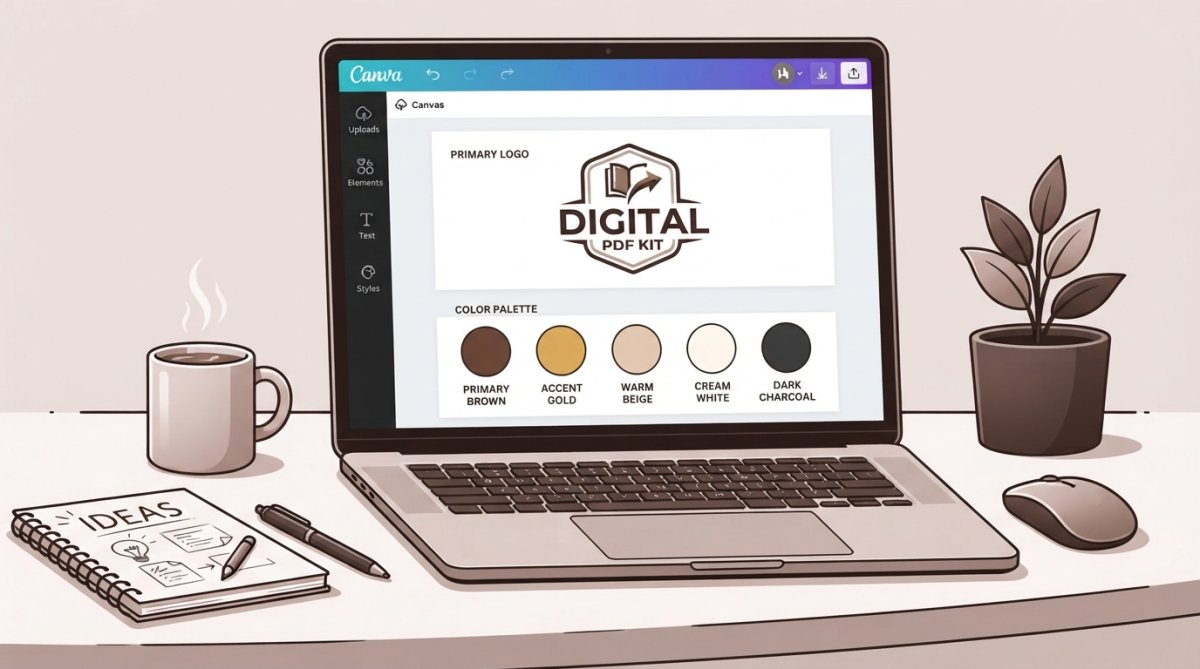
Brand identity for digital products means answering three core questions: Who are you? What do you offer? Why does it matter? Your answers need to be specific enough to guide every decision you make, from your logo colors to your email subject lines.
Establish Your Niche and Target Audience
The biggest branding mistake is trying to appeal to everyone. When you target everyone, you appeal to no one. Your brand needs a specific person in mind, someone so vivid you can picture their frustrations and goals.
Define your niche by answering: What specific problem do your digital products solve? Who experiences that problem most acutely? What’s their income level, age range, and industry? The more specific you are, the stronger your brand positioning becomes.
A template pack for "small business owners" is vague. A template pack for "female solopreneurs in the coaching industry making $50K-$150K annually" is a brand. The second lets you speak directly to someone’s real situation. Your copy becomes sharper and your pricing feels justified.
Create Your Value Proposition
Your value proposition answers: "Why should I buy this from you instead of the free alternative or a competitor’s product?"
A weak value proposition: "High-quality templates for social media."
A strong value proposition: "Done-for-you social media templates that turn coaches into visible authorities in their niche, saving 10 hours per week on content creation without hiring a designer."
The second is specific, benefits-focused, and addresses a real trade-off. Your value proposition should be built on one or more of these foundations: speed, expertise, results, ease, price, or a combination. Write it in one sentence and use it consistently across your sales page, emails, and social media.
Design Visual Elements: Logo, Colors, and Typography
Visual identity is how customers recognize your brand at a glance. Your logo doesn’t need to be complex, the best logos for digital products are often simple and memorable, working at any size.
Color psychology matters. Blue conveys trust and professionalism. Orange suggests energy and creativity. Green signals growth. Choose colors that align with your brand personality and the emotions you want customers to feel.
Typography shapes how your brand sounds. A serif font feels traditional. A sans-serif font feels modern and clean. A script font feels creative. Your font choices should reinforce your brand personality.
Use Canva’s brand kit feature to lock in your colors, fonts, and logo so every design stays visually consistent. This consistency builds brand recognition over time.
Your visual brand identity should be consistent across every touchpoint: your website, sales pages, email templates, social media graphics, and your product itself. Consistency builds trust.
Build a Strong Brand Narrative for Your Digital Products
A brand narrative is the story you tell about who you are, why you started, and why your products exist. Strong narratives have a structure: you faced a problem, you found a solution, and now you help others do the same. This structure is powerful because it’s human and creates connection.
Tell Your Origin Story and Expertise
Your origin story doesn’t need to be dramatic, just real. The most effective origin stories answer: What was your problem? How did you solve it? Why do you want to help others solve it?
Example: "I spent three years as a marketing manager creating social media content from scratch every week. One day, I realized I could create a template system that would save me hours. That system became the foundation for [Your Brand]. Now I help other coaches do the same."
This narrative is relatable, specific, and credible. It explains why you understand your customer’s pain.
Document your expertise through case studies, before-and-after examples, and specific results. A course that claims "students make $10K in their first month" is more credible if you can show three real students who did exactly that.
Communicate Authority and Trustworthiness
Authority comes from demonstrated expertise. Share your knowledge generously through blog posts, free resources, and community engagement. When people see you giving away high-quality insights for free, they trust that your paid products are even better.
Trustworthiness comes from being honest about what your products can and can’t do. A description that says "This template will transform your business" is a red flag. A description that says "This template gives you a proven structure that has helped 200+ coaches save 5 hours per week on content creation" is credible because it’s specific.
Collect and display customer testimonials. Ask customers for specific feedback: "What was the biggest time-saver?" Specific testimonials are more credible than generic praise.
Develop a Digital Product Branding Strategy
A branding strategy is your roadmap for how you’ll build, communicate, and evolve your brand over time. Your strategy should address: How will you position your products? What channels will you use to reach customers? How will you differentiate from competitors?
Create Brand Guidelines and Consistency Standards
Brand guidelines specify how your brand should look, sound, and feel across all touchpoints. They prevent inconsistency and make it easier to delegate work.
Your brand guidelines should include:
- Logo usage: When to use full logo vs. icon, minimum sizes, clear space requirements
- Color palette: Primary colors, secondary colors, acceptable combinations
- Typography: Primary font, secondary font, font sizes for different uses
- Voice and tone: How you write, vocabulary you use, personality traits
- Imagery style: What types of photos or graphics you use
A one-page guide with visual examples is enough to start. Consistency compounds over time. Every customer interaction that reinforces your brand identity makes your brand stronger.
Differentiate from Competitors
Differentiation is what makes customers choose you instead of someone else. Many entrepreneurs compete on price, which is a losing strategy.
Identify what makes your brand different. Maybe you solve the problem faster, explain concepts more clearly, include personal support, focus on a specific niche, or use a unique methodology. Your differentiation should be real and defensible.
"We’re better quality" is vague. "We include 30 video tutorials while competitors only include PDFs" is specific and defensible. Communicate your differentiation in every marketing channel.
Essential Tools for Digital Product Creation and Branding
The right tools make branding faster and easier. You don’t need expensive software.
Design and Template Platforms
Canva is the industry standard for non-designers creating branded digital assets. It has thousands of templates, a drag-and-drop interface, and a brand kit feature that applies your colors and fonts automatically.
If you’re creating digital products in Canva, you can use The Digital PDF Business Starter Kit, which provides fully editable templates you can customize with your own branding. This approach saves weeks of design work and ensures your products look professional from day one.
Sales and Distribution Platforms
Your sales platform is where customers buy your products. It’s a critical part of your brand experience.
Gumroad is simple and creator-friendly. It handles payments, delivery, and customer management with your brand prominently displayed.
Etsy is best if you want to reach customers already searching for digital products.
Shopify gives you complete control over the brand experience. It’s more expensive but ideal if you’re serious about building a brand.
The Digital PDF Business Starter Kit includes done-for-you storefront templates that work with these platforms.
Marketing Digital Products to Build Brand Awareness
Creating a great product and building a strong brand identity isn’t enough. You need to get your brand in front of customers.
Use Content Marketing and SEO
Content marketing means creating valuable content that attracts your target customers. A blog post, YouTube video, or podcast episode that solves a problem your customers face builds trust and positions you as an authority.
SEO means optimizing your content so search engines rank it highly. If someone searches "how to create social media content faster" and your blog post ranks in the top three results, you get free traffic.
Create content that answers the questions your customers ask before buying. If you sell email templates, create content about "How to write emails that convert." This content attracts people who need your product and should be genuinely helpful, even if someone never buys.
Build Community and User-Generated Content
Community is one of the most underrated brand-building tools for digital products. A community of customers who support each other and advocate for your brand is invaluable.
You can build community through Facebook Groups, Discord servers, email communities, or customer forums. User-generated content, when customers post screenshots of your templates in use or record videos using your course, is more credible than anything you could create yourself.
Encourage user-generated content by asking for it directly. "Share a screenshot of your favorite template and tag us on Instagram." Feature the best submissions on your website and social media. When customers see their work featured, they become brand advocates.
Common Mistakes When Branding Digital Products
Copying competitor branding. Your brand should reflect your unique perspective. Copying signals lack of confidence.
Inconsistent visual identity. Using different logos, colors, and fonts confuses customers. Build a brand kit and use it everywhere.
Vague positioning. "I help people succeed" is too vague. "I help overwhelmed coaches turn their expertise into a $10K/month digital product business" is clear.
Ignoring customer feedback. Your brand should be built on what your customers actually need. Talk to customers and let their language inform your messaging.
Treating branding as a one-time project. Your brand evolves as your business grows. Review your brand positioning annually.
Underestimating consistency. Small inconsistencies compound. Consistency is what makes brands memorable.
Skipping the brand narrative. Customers connect with stories, not features. Your origin story and mission make your brand human and memorable.
Building a strong brand for your digital products takes intention and consistency, but it’s one of the highest-return investments you can make. A well-branded product commands higher prices, attracts more loyal customers, and builds a business that compounds in value over time. The Digital PDF Business Starter Kit accelerates this process by providing fully editable, brandable templates, a complete roadmap for positioning your products, and done-for-you marketing resources. Get instant access today and launch your branded digital product business in weeks instead of months.
| Element | Purpose | Implementation |
|---|---|---|
| Logo & Colors | Visual recognition | Create in Canva or hire designer; apply consistently across all platforms |
| Brand Guidelines | Consistency standards | Document logo usage, colors, fonts, voice; share with any contractors |
| Value Proposition | Differentiation | Write one sentence explaining why customers should choose you |
| Origin Story | Trust & connection | Share how you solved the problem you now help others solve |
| Content Marketing | Authority building | Create blog posts, videos, or guides that answer customer questions |
| Community | Customer advocacy | Build Facebook Group, Discord, or email community for customers to connect |
Frequently Asked Questions
What is the difference between branding and marketing digital products?
Branding establishes who you are, your identity, values, and promise to customers. Marketing digital products is how you communicate that brand to reach your target audience. Strong branding creates recognition and trust, while marketing digital products drives visibility and sales. Both are essential: branding builds long-term authority, marketing generates immediate traffic and conversions.
How do I create a brand identity for digital products if I'm not a designer?
You don't need design skills to build a professional brand identity for digital products. Use fully editable templates in platforms like Canva to customize logos, colors, and typography. Many digital product creators use pre-designed templates as starting points, adjusting colors and fonts to match their vision. Focus on consistency, use the same color palette, fonts, and messaging across all platforms. This creates a cohesive brand without requiring advanced design expertise.
What tools should I use for branding digital products?
Essential tools for digital product creation and branding include: Canva for design and templates, brand guideline generators for consistency, and e-commerce platforms like Gumroad or Etsy for storefront branding. Many digital product creators use editable template kits that include pre-designed assets, reducing time spent on design. Your choice of tools depends on your budget, design comfort level, and the type of digital products you're selling, templates, ebooks, or online courses.
How can I make my digital product brand stand out in a crowded market?
Differentiate by building a strong brand narrative that communicates your expertise and authority. Share your origin story and why you created your digital products, this builds trust and connection. Develop a unique value proposition that clearly explains how your products solve customer problems differently. Leverage community and user-generated content by encouraging customer reviews and testimonials. Consistent, authentic branding across all channels, from your sales funnel to social media, creates visibility and authority that helps your digital products stand out.
This article was written using GrandRanker